Proche
Blog

5 Takeaways from “10 Practical Ways Product Experience Management Drives Business Impact”

Read Time:6 MINUTES
July 14, 2026

In Webinar 2 of our Agentic PXM series, Polly was joined by Hassaan, our Director of Consulting, and Jimmy, our Senior Director of Product, for a fast-paced look at 10 PXM use cases — organized by what you can act on now versus what to plan for next. 

If you missed it, here are the five biggest takeaways worth bringing back to your team. 

5 Takeaways from “10 Practical Ways Product Experience Management Drives Business Impact”

1. The 44% problem is a data problem, not a price problem 

Forty-four percent of buyers abandon a purchase when product information is incomplete. That’s nearly half of your potential revenue walking away — not because of price, not because of product quality, but because of data. 

Missing attributes. Inconsistent content. Products that don’t show up in search. Products that AI agents skip over entirely because the data isn’t structured for them to read. 

Every PXM use case worth investing in should ladder back to one of four symptoms of that 44% problem: 

  • Lost revenue — shoppers leaving without buying 
  • Retailer rejections — missing or non-compliant attributes blocking products from the shelf 
  • Invisible products — poor data signals burying SKUs in search 
  • Missed AI recommendations — agents skipping products without structured, trustworthy data 

If your roadmap doesn’t clearly attack one of those, it’s not solving the right problem. 

2. You don’t need an “agentic strategy.” You need a sequencing strategy. 

Ten use cases is a lot. The honest advice from the session: not everyone needs all of them, and you probably shouldn’t try to do them at once. 

Instead, sort your roadmap into three buckets: 

  • Quick Wins (live today): Auto-classification, attribute auto-fill, content generation, and translation. These four alone can collapse the time it takes a new SKU to go from inception to live on the shelf — and they’re available right now. 
  • Strategic Bets (in design and development): Full lifecycle orchestration, brand voice and content guardrails, and AVMT (Attribute Value Mappings and Transformations). Start the pilot conversations now so you’re ready when beta access opens. 
  • Future-Proofing (roadmap): Agentic commerce with AI-ready data, syndication on autopilot, and the self-improving shelf. These take cross-functional alignment, so the business case work starts today. 

The brands that win the agentic era aren’t the ones who try to leap to stage four overnight. They’re the ones who sequence intelligently and compound the wins. 

3. Governance isn’t a feature you bolt on. It has to be built into the agents themselves. 

The minute you tell a data, marketing, or product team that “everything will be automated,” the anxiety starts. What about that sensitive attribute I don’t want AI to touch? 

That’s the real tension with agentic PXM: lock it down too much and you lose speed. Let it loose and you risk errors on the attributes that matter most. 

The answer is not an on/off switch. It’s a dial. A truly agentic PXM has to give users controls at two levels: 

  • By category: Baby formula needs more oversight than baseball bats. Apparel can run with more autonomy than nutritionals. 
  • By attribute: You might let AI fill feature bullets 6–8 of a sunscreen, but never auto-edit drug facts, allergens, or nutrition info. Those always require human review. 

Users should also be able to tell AI: only fill gaps, don’t change anything already populated, or just flag inconsistencies, don’t generate new content. Governance shouldn’t be force-fit afterward. It should be baked into the agents from day one. 

4. Your brand voice is a competitive moat. Generated content shouldn’t sound generic. 

A company that manufactures hot sauce and a company that makes luxury watches can’t have the same tone — but most generative tools treat them like they should. 

An agentic PXM has to be able to define brand voice, target audience, character of content, purpose keywords, and banned words (the compliance and legal terms that can’t appear in marketing copy). It also needs to support different style guides per brand or per category, so the same engine can sound on-brand for every product line in your portfolio. 

This is the difference between content that scales and content that sounds like everyone else’s. Build the guardrails in, and generative features become safe to actually turn on. 

5. Discovery is moving from the search box to the AI agent. Your data has to follow. 

The biggest long-term shift Jimmy walked through: consumers are no longer starting their journey on your PDP. They’re starting it in Rufus, Sparky, ChatGPT, and Gemini — before they ever land on your site. 

Most product data was built for human-readable PDPs, not for machine consumption. That’s the gap. 

Winning here means thinking in three layers: 

  • SEO — rankings in traditional search 
  • GEO — citation in generative AI conversations 
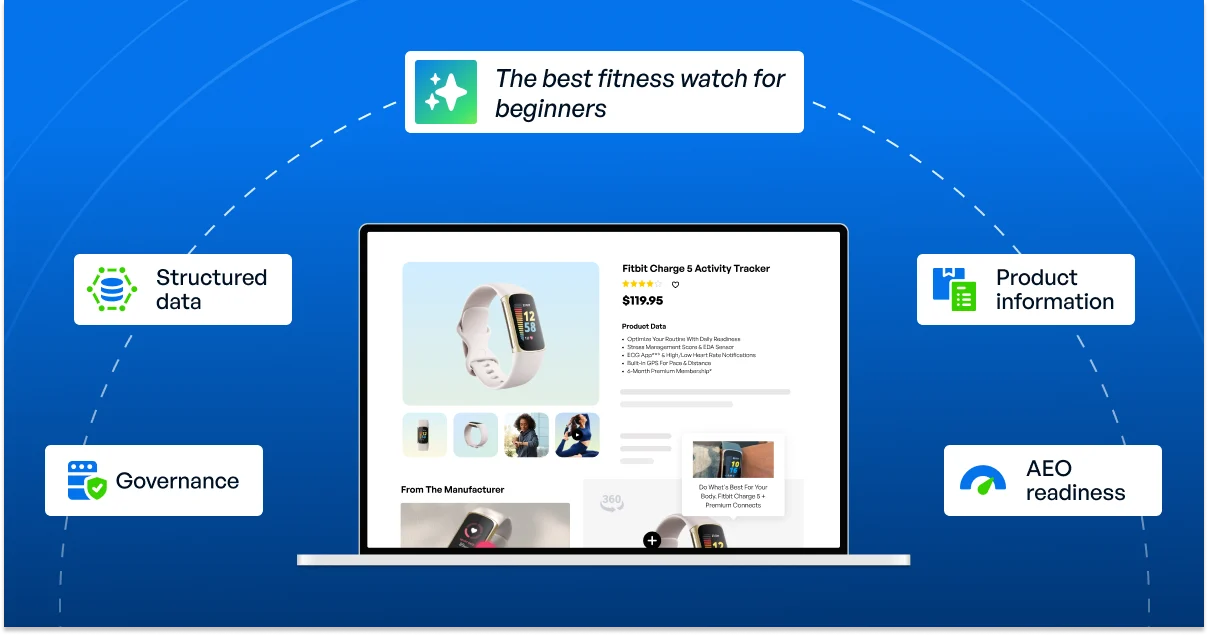
  • AEO — recommendations from autonomous agents 

All three sit on the same foundation: AI-ready, structured, complete product content. And the brands showing up in AI answers today aren’t the ones with the biggest budgets — they’re the ones with the best data. 

The closing-the-loop piece matters too. Today, signals from the shelf (competitor price changes, ranking shifts, review trends) live in dashboards that someone has to interpret and act on manually. The optimization agent collapses that lag from weeks to minutes — monitoring signals, triggering content updates, and re-syndicating with human oversight where it matters. 

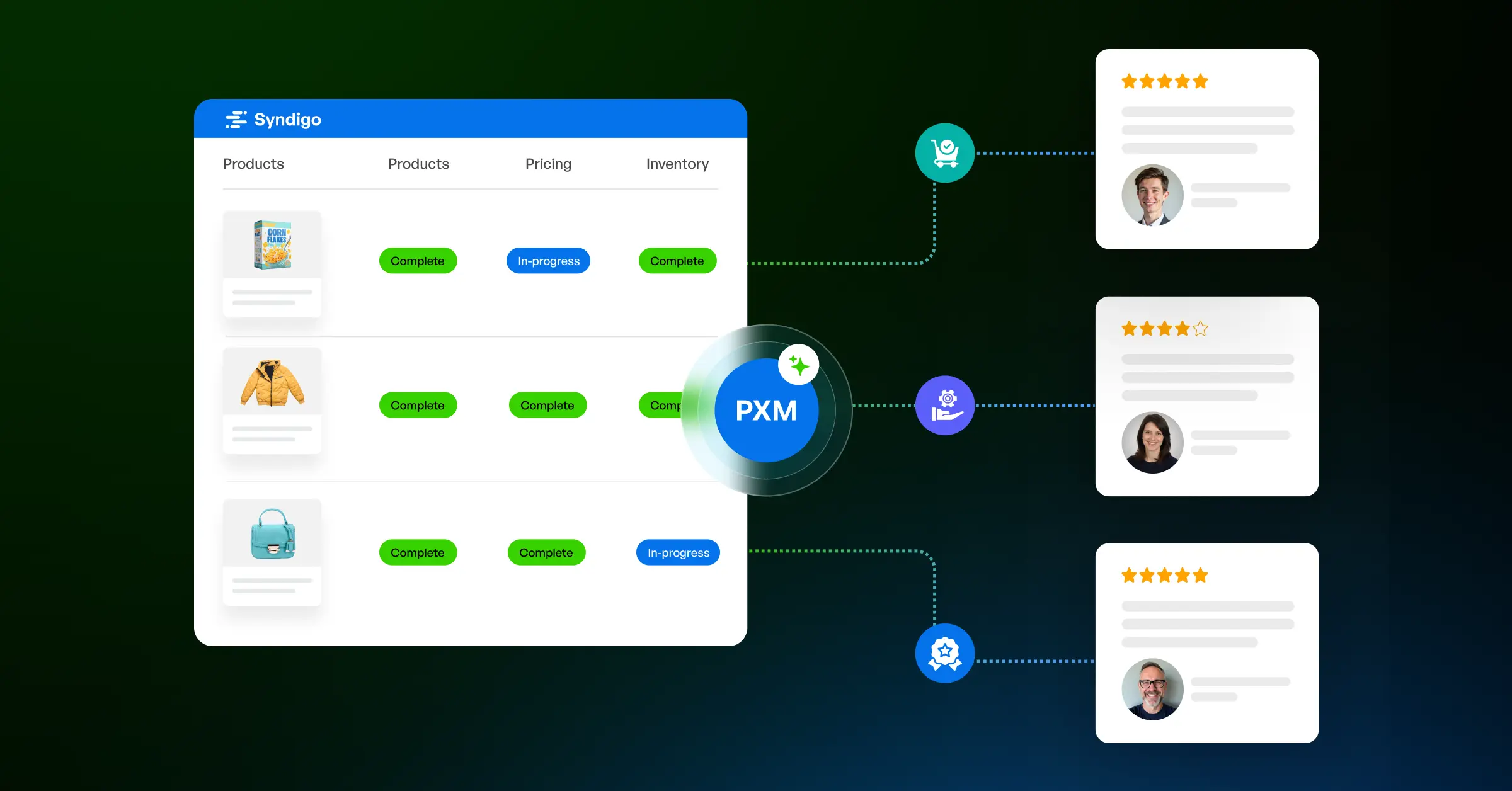
That’s the full picture of agentic PXM: Onboarding → Enrichment → Syndication → Optimization, built as one system, not as disconnected features. 

The bottom line 

Every use case discussed laddered up to the same four business outcomes: 

  1. Speed to shelf — get products live faster 
  1. Reduced rejections — cleaner syndication, fewer retailer pushbacks 
  1. Enrichment at scale — more SKUs, same headcount 
  1. Discoverability — in the age of AI agents 

Pick your bucket. Pick your starting use case. Don’t wait for the full roadmap to be live before you start compounding wins today. 

10 Practical Ways Product Experience Management Drives Business Impact