fechar
BLOG

Agentic PXM vs. Agentic Commerce: What you need to know to stay ahead 

Read Time:5 MINUTES
June 12, 2026

If you’ve been following the rapid evolution of AI in commerce, you may have heard two terms come up again and again: Agentic Commerce and Agentic Product Experience Management (PXM).

The two are related, but not interchangeable. Understanding where they differ (and how they connect) is critical for navigating what comes next.

Too Many Channels. Too Much Complexity.

A 5-part guide for agentically managing product experience at scale

What is Agentic Commerce?

At a high level, agentic commerce describes a shift in how buying happens.

Instead of shoppers manually searching, comparing, and deciding, AI agents increasingly mediate those decisions: gathering information, evaluating options, and even completing purchases and organizing fulfillment on a consumer’s behalf. “Agentic commerce is a shift in how buying is happening…” said Benny Blum, Syndigo’s SVP of Product in a recent webinar. “The agent does the research, comparison, recommendation—and increasingly even the transaction.”

This isn’t just a new channel. It reflects a broader shift across the commerce ecosystem, with agents helping shoppers discover and evaluate products on the front end while AI increasingly influences inventory, fulfillment, and assortment decisions behind the scenes. At the same time, discovery is moving away from traditional browsing and toward conversational, contextual, constraint-based queries.

The result is a faster, more automated buying journey where a previously extended and multitouch research process compresses into seconds on a single chat interface. 

In this new environment, visibility defines eligibility for consideration. If your product data isn’t structured and complete, your products simply don’t exist in the decision set. 

What is Agentic Product Experience Management? 

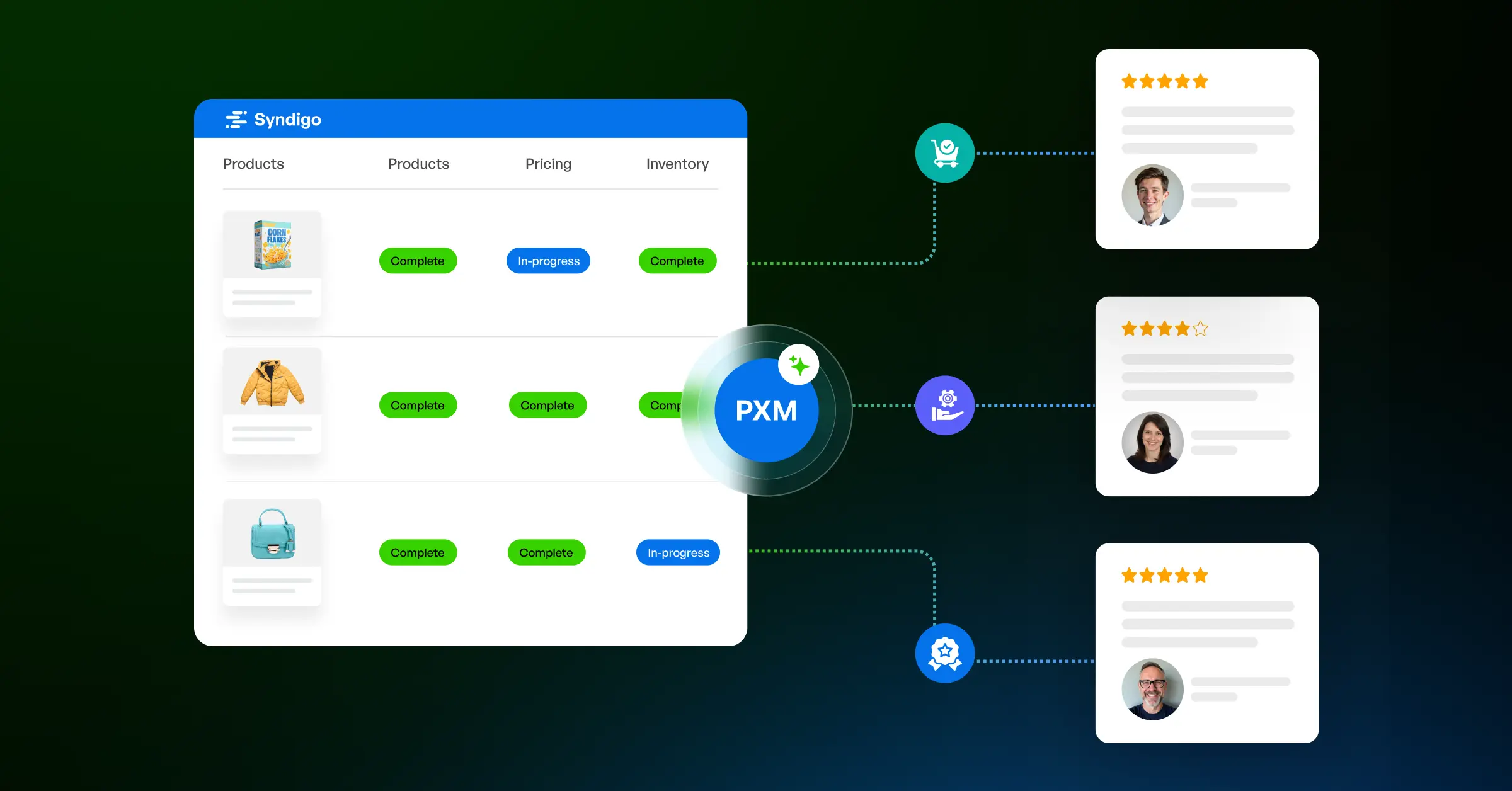
If agentic commerce is what’s happening in the market, agentic PXM is how organizations respond to it internally. 

The traditional work of product experience—creating, enriching, validating, and deploying product data—has become increasingly complex. More channels, more requirements, more variability. 

Agentic PXM introduces a new operating model. Rather than relying exclusively on human-driven cycles, agentic PXM introduces AI agents that autonomously detect what’s happening, decide what matters, and act within defined guardrails.

In practical terms, agentic PXM means AI agents are continuously monitoring product data quality and performance, enriching and validating information as it moves across systems, taking action automatically when confidence is high, and escalating decisions when human judgment is needed. 

Instead of reacting to errors after the fact, organizations can operate in a continuous, always-on model. 

Key differences 

While the terms are often used together, they operate in completely different domains: 

Agentic Commerce 

  • External, market-facing 
  • Focused on how buying happens 
  • Driven by AI agents interacting with consumers and commerce systems 
  • Optimized for discovery, recommendation, and transaction 

Agentic PXM 

  • Internal, operational 
  • Focused on how product data is prepared and managed 
  • Driven by AI agents embedded in workflows 
  • Optimized for data quality, scalability, and control 

Or more simply: 

  • Agentic commerce is the environment 
  • Agentic PXM is your ability to operate within it 

How they work together 

These two concepts aren’t separate trends: they’re tightly connected. 

In fact, the rise of agentic commerce is what makes agentic PXM increasingly necessary. 

AI agents rely on structured, machine-readable product data to function. 

They don’t interpret incomplete information and have low tolerance for inconsistencies. They will give preference to brands, products, sellers and platforms with accurate, accessible, machine-readable information and overlook those without it.  

As Benny explained: “The standard has gone up here because a human will tolerate a missing piece of information, because if they’re really interested, they’re going to go find it, and an AI agent won’t…That was a data operations problem historically, and in the agentic world, that’s more of a revenue problem because you’re not even in the consideration cycle.” 

That creates a new kind of demand: more attributes, more consistency across channels, more real-time accuracy, and more structured, governed data. 

And that demand is only increasing as agentic commerce scales. Today, most teams and processes just aren’t built to handle that level of complexity and scale manually. 

“That was a data operations problem historically, and in the agentic world, that’s more of a revenue problem”

That’s where agentic PXM comes in. 

By introducing coordinated agents across product workflows, organizations can scale enrichment and validation across entire catalogs, keep data aligned with constantly changing requirements, and ensure products are ready for AI-driven discovery environments. 

In essence, agentic PXM is the engine that makes agentic commerce possible. 

Why acting now matters 

Agentic commerce isn’t a future-state concept; it’s already reshaping how products are discovered and purchased. But it’s still early enough that there’s still plenty of room for early adopters to establish their place and get an edge. 

The growing gap between what agentic commerce demands and what current product operations can deliver creates both risk and opportunity. Organizations that adapt can ensure their products are visible in AI-driven environments, consistently recommended, and positioned to win in faster, more automated buying journeys as those processes evolve. 

How to get started

Understanding the difference between agentic commerce and agentic PXM is the first step. The next is figuring out how to bridge the gap.

If you want a deeper look at how to operationalize this shift, and what it means for your organization, download our guide: Too Many Channels. Too Much Complexity: A 5-part guide for agentically managing product experience at scale