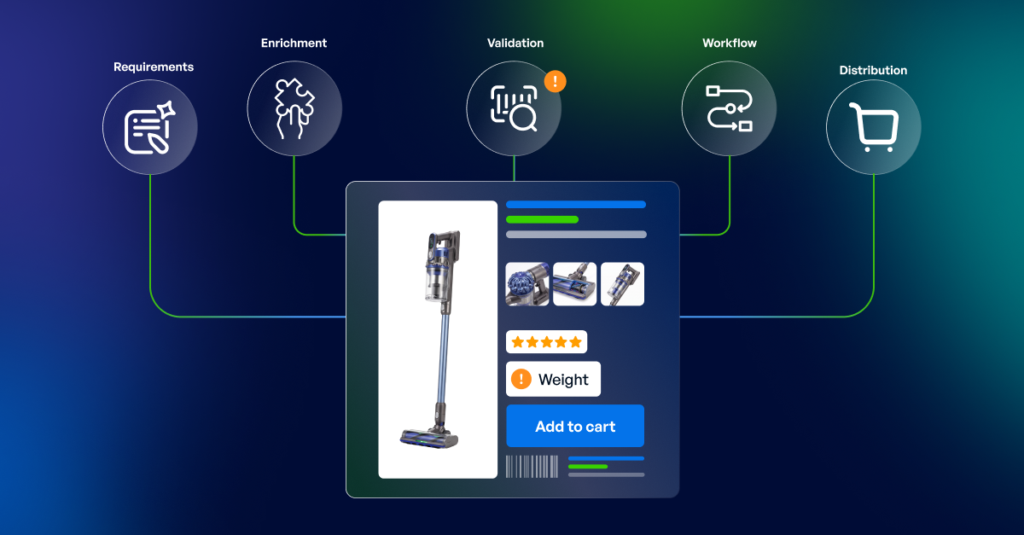


Someone asks whether the new cordless vacuum is ready to send to the retailer.
It sounds like a yes-or-no question. Answering it means opening the spreadsheet where the specs were drafted, the shared drive where the photographer dropped the images, the email thread where legal settled the warranty wording, and the retailer’s template to see which required fields are still blank. Three of those four sources are current. Nobody can say which three.
The first article in this collection followed what happens after someone guesses and guesses wrong: How One Product Data Error Becomes Everyone’s Problem. This one is about the part that comes first. Before a business can stop a bad value from traveling, something has to own the record while it is still being built.
The work has a name before it has software
Product information management is the practice of collecting, validating, formatting, and monitoring the information used to market, merchandise, and sell products through the channels a business sells in. That is a description of work, not of a screen. Syndigo’s own PIM 101 guide makes the point directly: PIM is not simply technology, but a process.
A PIM solution is the software built to support that work at the volume most businesses actually operate at. Syndigo’s glossary draws the same line, describing PIM software as the application used to manage product information within a PIM system.
The distinction matters more than it sounds. A company that buys the software and keeps the same undefined requirements, the same unassigned reviewers, and the same private spreadsheets has bought a faster version of the situation it already had. The work is what changes. The software is what makes the work survivable once there are 40,000 records and 60 retailer templates instead of four and one.
Someone has to define what a finished record means
Before the vacuum’s record can be filled in, the business has to say what filled in means for a vacuum.
That definition comes from a few places at once. The taxonomy places the product in a category, and the category carries a set of attributes the record is expected to have: suction rating, run time, dust capacity, cord type. Regulated attributes carry their own requirements. Each retailer adds its own required fields and its own formatting, which is why the same product can be complete for one buyer and rejected by another on the same afternoon.
Business rules are where those expectations stop being tribal knowledge. A rule states that run time is required for this category, that it is expressed in minutes, that it cannot be blank when the record is submitted. Written down that way, the requirement is something the system can check and something a new hire can read. Held in someone’s head, it is a habit that leaves when they do.
This is the least glamorous part of product information management and the part that determines everything after it. A record can only be measured against a standard that exists.
Enrichment is the part everyone recognizes
A product record starts as a stub. Somebody typed a name, a code, and a price into an ERP because the finance side of the business needed those three things. Nothing about that stub helps a shopper choose the vacuum over the one next to it.
Enrichment is the work of turning that stub into something that can describe and sell the product. Copy gets written. Specifications get filled in. Images, video, and other digital assets get attached to the record rather than living in a folder that only the creative team can find. Product relationships get built, so the three colorways read as variants of one model instead of three unrelated listings, and the replacement filter is connected to the machine it fits.
Syndigo PIM supports this work with centralized management of product data, assets, taxonomy, and relationships, plus AI-powered enrichment, attribute mapping, and bulk editing for the parts of the job that repeat across thousands of records.
The change here is quieter than it looks. The people doing the enriching are the same people. What moves is where the result lands: in the record, where the next person can see it, instead of in a file named vacuum_specs_FINAL_v3.
Validation catches the problem while the record is still yours
Once requirements are written as rules, the system can check the record against them.
Validation is what tells a category manager that the run time field is empty, that the weight was entered in pounds where the retailer expects kilograms, that a duplicate record for the same product already exists, that the image attached is below the resolution the destination requires. Syndigo PIM applies automated error checking, deduplication, and business-rule-driven validations to this step.
Consider what this changes about timing. A rule that runs against the record catches the missing value while the record is still an internal draft. The alternative, which most businesses live with, is finding out from a rejected feed, a retailer chargeback, or a customer. The information is the same. The cost of learning it is not.
Validation does not make a record true. It confirms the record satisfies the rules configured for it. A weight entered as 8.2 kilograms when the real weight is 6.8 will pass every format check ever written.
Workflows put a name next to every unfinished field
Most product-information problems are not knowledge problems. They are assignment problems. Everyone knows the marketing copy is missing. Nobody is certain whose Tuesday it belongs to.
Workflows are how a PIM handles that. The record moves through defined steps with a role attached to each: the specifications go to the product team, the copy goes to marketing, regulated attributes go to whoever is accountable for them, and the record does not advance to publication until the review step is complete. Syndigo PIM supports this through workflow automation and validation rules tied to review.
What this gives a business is visibility into a job that used to be invisible. A director can see that 300 records are waiting on one person’s approval, which is a staffing conversation rather than a data conversation. Ownership becomes something you can look at instead of something you reconstruct after a problem.
Only approved information leaves
The last step is preparing what has been approved for the places it needs to go.
Each destination wants the record its own way. A retailer has required attributes and formatting. A marketplace has different ones. A regional site needs localized content. Syndigo PIM prepares and publishes product information for retailers, marketplaces, ecommerce sites, and other digital channels, with support for localization and retailer-specific requirements.
The practical difference from the earlier setup is worth stating plainly. In the disconnected version, adding a channel means creating and maintaining another separate copy of every product detail. In the managed version, the channel becomes another output of one record. Correcting the vacuum’s weight is one correction that flows to the destinations the record feeds, rather than a task list of edits performed by hand in a portal.
What the software will not do for you
A PIM is a place where product-information work happens under rules. It is not a machine that produces accuracy.
It will not correct a wrong value at its source. If the supplier’s spec sheet says 6.8 kilograms and the real product weighs 8.2, a validation rule will confirm the record is well-formed and completely wrong. It will not decide who owns an attribute, which is an organizational decision that has to be made by people with the authority to make it. It will not remove manual work, though it does concentrate that work in one place and remove a large share of the re-keying. It will not control a copy someone exported to a spreadsheet last quarter and is still emailing around.
And the rules only cover what someone took the trouble to define. An unwritten requirement is not enforced by any system, no matter what it cost.
So what does a PIM actually do?
It gives product information a managed path through the business.
That is the whole answer, and it is more useful than it first sounds. The vacuum record enters a defined process. Requirements say what it needs. Enrichment supplies it. Validation checks it. Workflows assign it and move it through review. Approved information goes out to the channels that asked for it. At every one of those points there is a rule, a role, and a record you can look at, which is exactly what the spreadsheet-and-email version could never produce.
Whether that path works at your company is a separate question from whether you have the software. The processes around the record, and the people accountable for them, decide how much of this you actually get.
Read PIM 101: From Data Management to Driver of Commerce for a deeper look at how product information management works.