

New findings show what earns shoppers’ trust and why it matters across the executive suite.
Getting the product page right used to separate the leaders from everyone else. Now it’s the price of entry. The basics are simply expected wherever your products appear.
Fewer shoppers are running into bad product experiences than last year. That’s real progress, and it’s also the reason the job changed.
You can be found by everyone and still be chosen by no one. Product experience shapes that choice
For the CEO: The product page is a revenue lever
A product page makes a promise about what will show up at the customer’s door. It has to earn the click and hold up when the box opens.
Incomplete information sends 83% of shoppers looking elsewhere. A product that fails to match the promise creates a second risk: the sale comes back as a return. For 26% of shoppers, the gap between the page and the product ended that way, up five points from last year.
The National Retail Federation projected $849.9 billion in returned merchandise in 2025, including 19.3% of online sales. Product information does not explain all of it. The expectation gap is only one piece of the returns problem, but it is one that brands can do something about.
Make the promise clear and accurate on the product page, and shoppers have fewer reasons to walk away or send the product back.
For the CMO: The product page can erase the value marketing created
Marketing can do its job and still lose the shopper at the product page. The campaign may have earned the attention and the brand a place in consideration, but the product still has to prove it deserves both.
When products are represented inaccurately or incompletely, 80% of respondents view the brand less favorably. A missing detail or misleading image can weaken months of marketing work in seconds.
Shoppers make that judgment using the evidence on the page. Ratings and reviews were selected among the top purchase considerations by 53% of respondents, while detailed product descriptions were selected by 52%. Brand reputation was selected by 35%. The reputation marketing built still matters, but shoppers want something concrete to believe.
The product page can drain the value from the attention marketing worked so hard to earn.
For the CIO and CDO: Product data now has a customer-facing job
AI never sees the product. It sees the record built around it.
Every attribute, description, image, and review becomes part of how an AI system understands and compares that product. The gaps travel with it, leaving the system to work around missing details, conflicting claims, or language it cannot confidently interpret.
That already matters to the purchase. 25% of respondents said an AI recommendation would make them more likely to buy. The recommendation may reach the shopper, but its foundation reaches back through the systems responsible for creating, structuring, and governing the product data.
AI turns the product data architecture into part of the customer experience.
For the VP of eCommerce and Merchandising: Conversion does not have to come at margin’s expense
Shopper hesitation does not always call for a sharper offer. Sometimes the product has simply left too much unresolved.
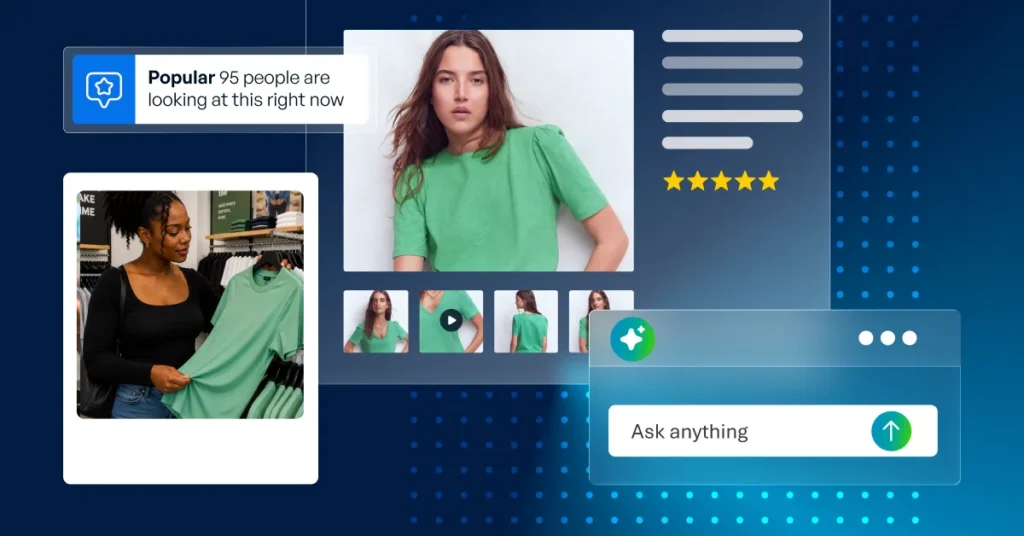
The report points to another path to conversion. Syndigo benchmark research found that rich media lifts average add-to-cart rates by 39%, helping shoppers understand the product without requiring a lower price to move the decision. Reviews add the reassurance that the product has already delivered for someone else.
A clearer, better-validated product experience gives shoppers fewer reasons to hesitate and eCommerce leaders more room to protect margin.
Before lowering the price, close the confidence gap.
Getting chosen is everyone’s job
At the moment of choice, the org chart disappears. The shopper does not separate the campaign from the product page, the product page from the data behind it, or the offer from the confidence needed to accept it.
All of that arrives as one product experience.
The consequences look different depending on the title, but they start in the same place. Whether the product gives shoppers enough confidence and AI systems enough information to recommend it.
No single team owns the product experience. And no single team escapes it when it breaks.
The data is clear on what earns the choice. The only question is which companies act on it.